What Is a Tinplate Aerosol Can? Manufacturing, Benefits and Applications
September 24, 2026
Автор
Благодаря профессиональной технической команде мы предоставляем клиентам целенаправленные рекомендации по выбору оборудования и комплексное послепродажное обслуживание, завоевывая доверие и признание клиентов.
Сара М.
You need a reliable packaging solution for pressurized products. What Is a Tinplate Aerosol Can? A tinplate aerosol can is a pressurized metal container made from tin-coated steel. It dispenses products as a fine mist or foam. The global aerosol cans market is growing at a 5.7% CAGR. Manufacturers choose tinplate for its strength and recyclability.
Key Takeaways
Tinplate aerosol cans offer high strength and are almost 100% recyclable. They often cost less than aluminum cans.
Match the tin coating thickness to your product type. Use thicker coatings for acidic formulas and thinner ones for neutral products.
Manufacturers use precise welding and strict tests to keep defects below 0.3%. This ensures safe and reliable packaging.
What Is a Tinplate Aerosol Can?
Definition and Core Structure
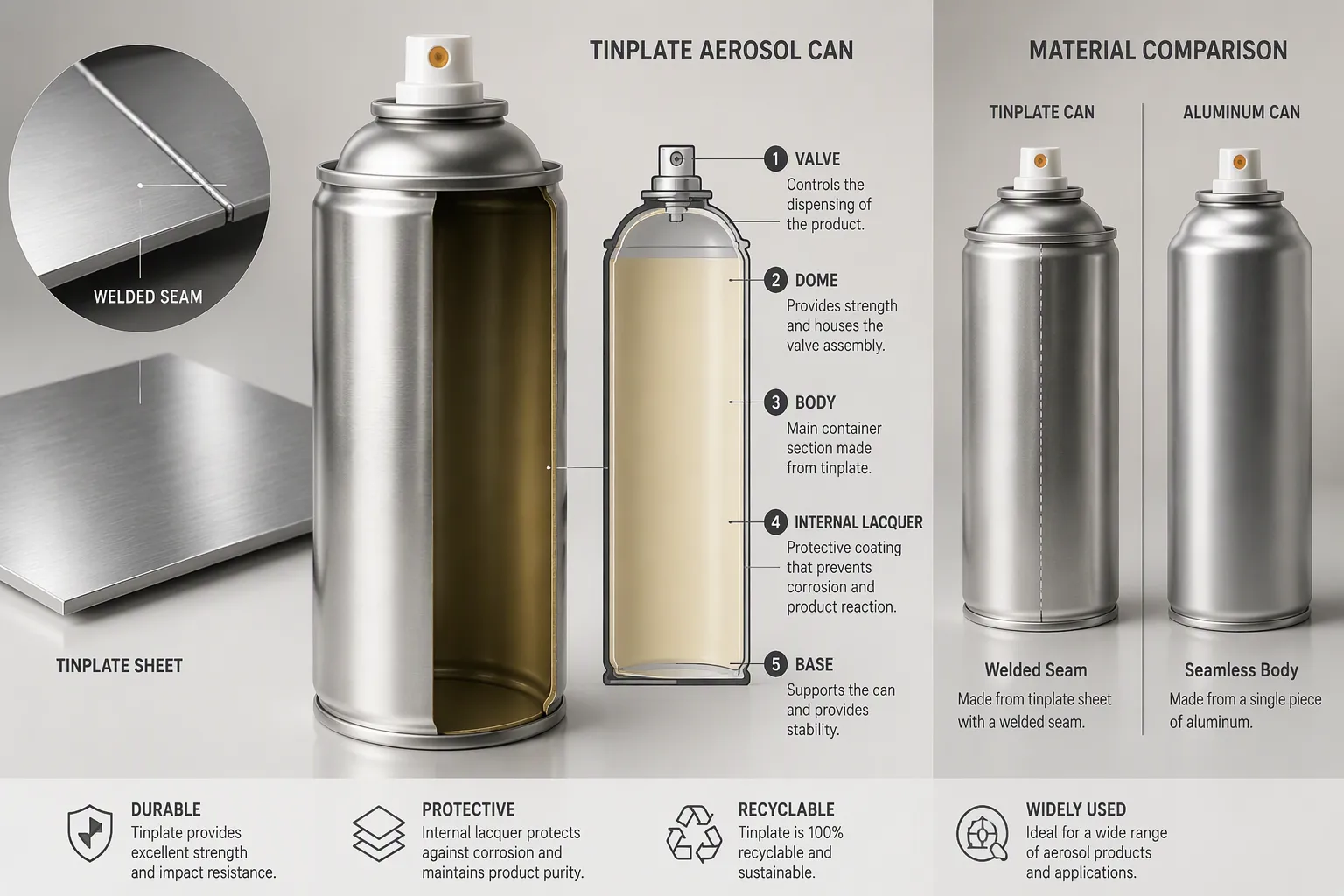
Tinplate is a thin steel sheet coated with a layer of tin. Manufacturers form this material into a pressurized container that dispenses products as a mist, foam, or spray. That finished product is a tinplate aerosol can. The tin layer protects the steel from corrosion, while the steel provides mechanical strength.
A standard tinplate aerosol can has several main parts. The body is the cylindrical wall that holds the product and propellant. The dome sits on top and connects to the valve. The base forms the bottom and often curves inward to resist internal pressure. The valve controls the release of the contents. An internal lacquer lines the inside surface to separate the formula from the metal.
The internal lacquer works as a physical barrier. It keeps water-based formulas from touching the tinplate underneath. Corrosion starts at weak points like pinholes, scratches, or exposed cut edges along a seam. A proper lining must resist water, cover weld seams completely, maintain adhesion under pressure, resist permeation, and survive repeated wet-dry cycling. Even microscopic voids can become starting points for pitting corrosion.
Tinplate vs. Aluminum Cans
You face a real choice between tinplate and aluminum for metal aerosol packaging. The two materials differ in manufacturing method, pressure performance, corrosion resistance, and cost.
Tinplate cans start as flat sheets that workers cut, weld, and seam into shape. Aluminum cans typically use impact extrusion, where a press forces a metal slug into a die to form a seamless body. Sheet forming gives tinplate an advantage in production flexibility.
Pressure performance favors tinplate. For a typical 202 diameter end, tinplate cans reach burst pressures of 220–290 psi. Aluminum cans reach 150–200 psi for the same end dimensions. Hydrostatic burst testing is the standard method, with test pressure usually set at 1.5× the working pressure.
Corrosion resistance depends on the product. Acidic formulas need thicker tin coatings. Neutral products can use thinner options. The table below shows standard coating weights.
Product Type
Tin Coating Weight Range (g/m² per side)
Acidic products
5.6–11.2
Neutral products
2.8–5.6
Cost often decides the choice. Tinplate generally costs less than aluminum for the same can size. This makes aerosol packaging materials based on tinplate attractive for high-volume production.
200ml–300ml: Perfect for travel-size or single-use personal care items like shaving foam or hair dry shampoo aerosol guide.
Standard tinplate can diameters include 45 mm, 52 mm, 57 mm, 60 mm, 65 mm, and 70 mm. Three-piece tinplate cans commonly use 45 mm, 52 mm, or 65 mm diameters.
Tinplate Aerosol Can Manufacturing
Raw Materials and Can Body Forming
Grade selection drives every downstream decision. Acidic formulas demand thicker tin coatings, while neutral products tolerate thinner options. The table below shows the standard grades for tinplate aerosol can bodies.
TH660 serves as the standard grade for most can bodies. Its high strength and consistent weldability suit high-volume production. BA T5 works where lower internal pressure is acceptable. DR9 fits non-food cans that require the highest burst resistance.
Surface finish and lacquer compatibility matter just as much. You need a smooth, consistent surface for proper lacquer adhesion. The lacquer must match the formula inside. A mismatch causes blistering or delamination under pressure.
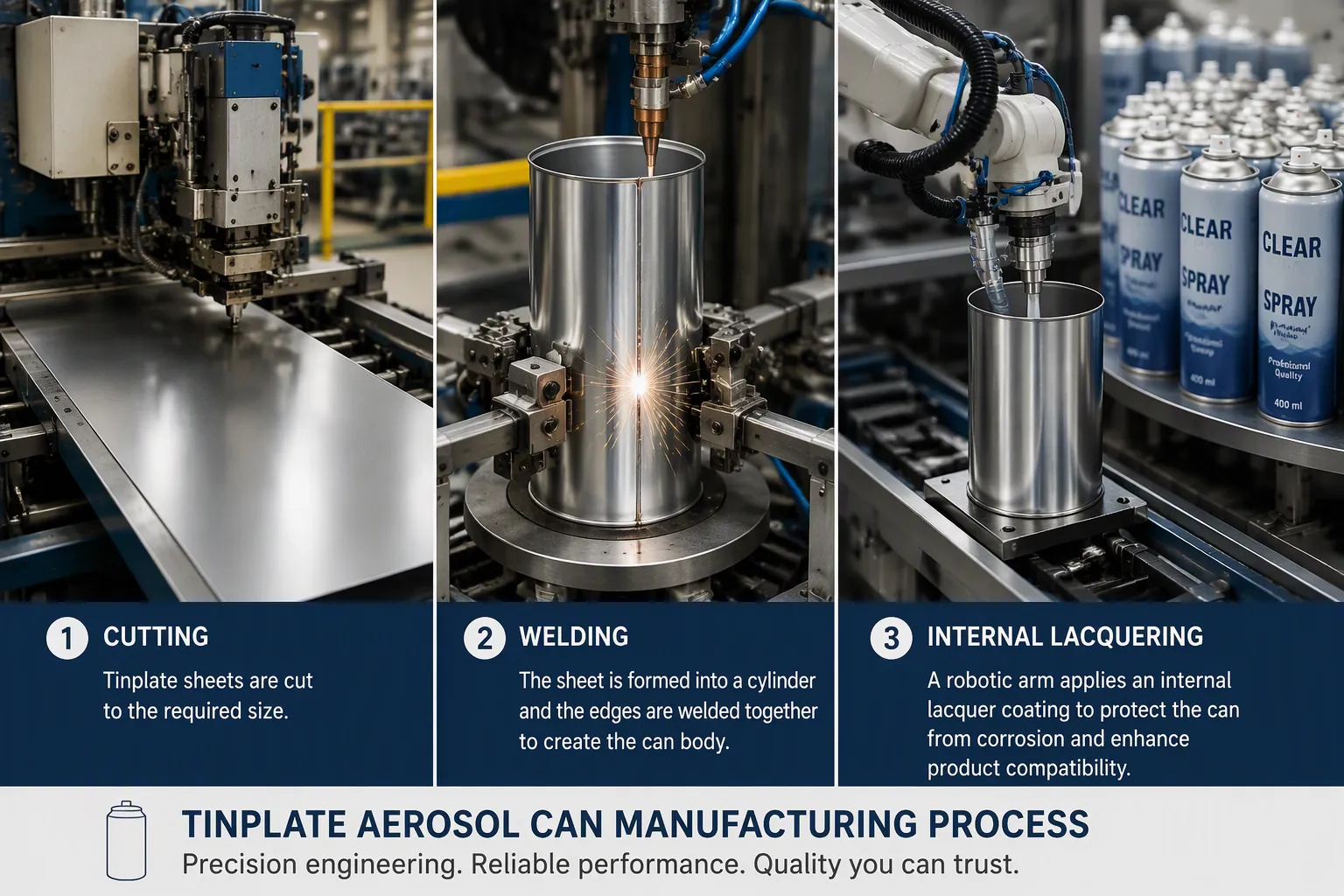
Sheet forming follows a clear sequence. Workers cut flat tinplate sheets to size. They weld the edges into a cylinder or draw the body from a single piece. Seaming joins the edges. Dome and base formation shape the top and bottom. Welded can bodies in three-piece aerosol can manufacturing achieve a defective rate below 0.3% (less than 3 per 1,000 units), which implies a production yield rate above 99.7%.
Welded can bodies in three-piece aerosol can manufacturing achieve a defective rate below 0.3% (less than 3 per 1,000 units), which implies a production yield rate above 99.7%.
Coating, Assembly, and Filling
Internal and external coatings protect the can and the product. The internal lacquer separates the formula from the metal. The external coating provides corrosion resistance and carries branding. Both layers must survive the forming process without cracks.
Valve assembly demands strict quality control. You test valves to design limits of temperature and pressure. For delivery volume, sample 50 valves. For deliveries ≤54 µL, apply a ±15% limit. For 55–200 µL, apply a ±10% limit. If 4 or more valves fall outside limits, reject the batch. If 3 fall outside, retest with 25 new valves. Accept if 1 or fewer fall outside; otherwise reject.
Leak testing follows a defined method. Check crimping dimensions first. Pass filled containers through a water bath. Weigh 12 randomly selected containers (W1). Store them upright at 25°C±2°C for at least 3 days. Re-weigh (W2) and record test time (T). The average leakage rate of 12 containers must stay below 3.5% of net filled weight per year. No single container may exceed 5% per year.
Additional checks include:
Leak testing
Performance testing at various temperatures
Pressure resilience testing
Durability testing to ensure consistent performance
Precision manufacturing and quality control are applied at every stage. Companies monitor weld integrity, coating thickness, and valve performance. This discipline keeps defect rates low and protects your product throughout its shelf life.
Benefits and Applications of Tinplate Aerosol Cans
Key Benefits for Product Packaging
You get durability and mechanical strength from the steel core. A tinplate aerosol can resists denting better than aluminum. The tin coating adds corrosion resistance. Internal lacquer creates a barrier against acidic or neutral formulas. This dual protection keeps your product stable throughout its shelf life.
Pressure performance sets tinplate apart. Tinplate cans are designed to withstand high internal pressures, with burst pressures typically ranging from 18 to 22 bar. These thresholds mean your formula stays safely contained, even during transport or storage in warm conditions.
Recyclability strengthens the business case. Tinplate is nearly 100% recyclable and does not lose quality when recycled. These characteristics support a circular economy and create economic opportunities for your brand.
Cost stability matters for long production runs. Tinplate raw material prices show lower volatility than aluminum. The table below compares key parameters.
Parameter
Tinplate
Aluminum
Raw Material Price Index
100 (baseline)
135–160
Dent Resistance
High rigidity
Moderate
Production Method
Welded
Seamless Extrusion
"Steel aerosol packaging continues to hold strong in industrial and household categories due to cost efficiency and established recycling systems," notes the 2025 European aerosol market review published by FEI.
Common Industry Applications
You find metal aerosol packaging across many sectors. Personal care products include deodorant and hairspray. Household items cover insect spray and air freshener. Automotive applications use paint and lubricant. Industrial formulas include cleaners and adhesives. Food products like whipped cream rely on tinplate for safe dispensing.
Each application benefits from the same core strengths. Acidic formulas need thicker tin coatings. Neutral products work with thinner options. This compatibility makes aerosol packaging materials based on tinplate versatile across industries. High-speed welding output supports bulk production. Proven anti-corrosion linings protect sensitive formulas. Tinplate remains a preferred material because it balances cost, safety, and sustainability.
What Is a Tinplate Aerosol Can? You know its structure, manufacturing, and benefits. This reliable, recyclable packaging suits many industries across personal care, household, automotive, and industrial markets. Choose tinplate aerosol can solutions for your products. Tinplate will remain central to sustainable metal aerosol packaging and aerosol packaging materials.
FAQ
What makes tinplate better than aluminum for aerosol cans?
Tinplate offers higher burst pressure ratings and lower raw material costs. A tinplate aerosol can also resists denting better than aluminum alternatives.
How do you choose the right tin coating for your product?
Match coating weight to your formula. Acidic products need thicker tin coatings. Neutral formulas work with thinner options. This protects your aerosol packaging materials from corrosion.
Why does recyclability matter for metal aerosol packaging?
Steel packaging is highly recyclable and retains quality through repeated recycling cycles. You support a circular economy when you choose metal aerosol packaging.

 en
en ru
ru es
es pt
pt zh-CN
zh-CN